Quarterly Confessions: When Commodity Rebalancing Meets the War Machine
Navigating the Q1 Cash Sweep, Commodity Volatility, and the Secret Yield Tailwind.

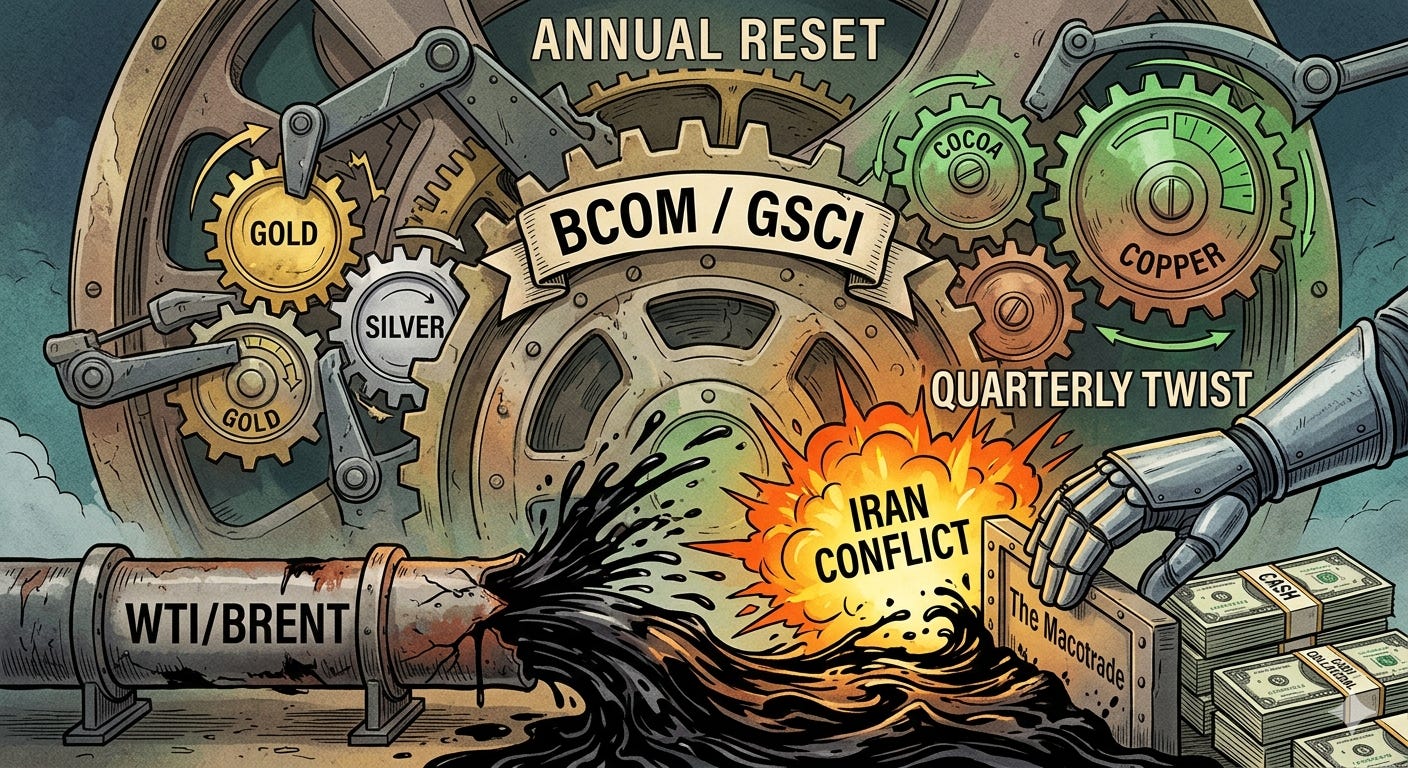
If you’ve been following me for some time now, you know I’m obsessed with the plumbing of the markets. It’s one thing to trade a headline; it’s another to trade the mechanical flows that move billions while everyone else is distracted by the noise. And boy has there been a LOT of noise recently.
Back in January, I broke down the Annual Commodity Index Rebalance. It was a massive reset for the Bloomberg Commodity Index (BCOM) and the S&P GSCI to ensure they actually reflected the real world—not just the sectors that had a “moon mission” in 2025.
But as we close out Q1 2026 today, we’ve hit a fascinating crossroads. We aren’t just dealing with the roll of futures contracts on commodities that are extremely volatile right now; we are also dealing with a massive cash rebalancing within etf’s colliding with a Treasury market that’s finally waking up.
The Annual Foundation: A Refresher
For those who missed my January DD on Commodity Index Rebalancing, I detailed how rebalancing is the index’s way of preventing dominance amongst individual commodities and appropriately weights them according to annual flows, volumes and prices.
Here’s the original 4-1-1…
Commodity index rebalancing is a periodic process where major commodity indices, such as the BCOM and the GSCI, adjust the weights of the commodities in their basket.
It’s an annual “reset” to ensure the index still reflects the real-world importance of each commodity, such as its production levels and liquidity, rather than just which ones happened to have a massive price rally recently. This rebalance is much more significant than past years after the meteoric rise in 2025 of precious metals coupled with low oil prices.
Why?
1. Prevents Dominance: If a specific commodity has a huge year, as we’ve seen with gold & silver, its weight in the index grows because its price went up. Rebalancing trims these positions so one commodity doesn’t end up controlling the entire index’s performance.
2. Reflect The Real World: It adjusts the basket to match current global production and trading volume.
3. Risk Management: It ensures diversification so passive investors aren’t accidentally over-exposed to a single sector.
How the Process Works
The rebalancing occurs annually in January, specifically the 5th through 9th business days. There are 3 specific events that happen during the rebalance:
1. Set Target Weights: Index providers announce new target percentages based on production data and liquidity over the previous year.
2. The “Roll” Period: Over several days, funds that track these indices must readjust their baskets in-line with their new target weights. They will sell their winners, commodities that now exceed their target weight, and buy the losers, those that are below their target.
3. Set Caps and Limits: Most indices have rules to ensure no single commodity exceeds a certain limit and no single sector exceeds a cap.
Impact of the Great 2026 Commodity Rebalance
In January, the index providers stepped in to trim the winners and buy the losers. This year was anything but typical:
The Cocoa Comeback: We saw Cocoa included in the BCOM for the first time in 20 years.
The Energy Shift: Despite the volatility, Energy weights were actually trimmed in the GSCI to make room for the massive percentage weight increase in Gold, which jumped from 5.10% to 7.24% in that index.
The Gold Paradox: Even though funds were “forced sellers” to bring Gold back down to its 14.90% BCOM cap, geopolitics kept a floor under prices. The theoretical dip didn’t materialize until the war on Iran began.
Talk about hindsight being 20/20. The 2 biggest shifts in the commodity rebalance were decreasing energy and increasing gold. Since the onset of the US/Iranian war, Oil has risen over $100/barrel, both WTI and Brent. Simul
taneously, gold prices have experienced a significant dip. However, Gold is still currently higher from it’s January price tag around $4,300/oz.
The Quarterly Twist: From Weights to Wheels
Ok, so the annual rebalance is behind us. We have since entered a war with Iran and the world is experiencing the largest oil supply disruption. Today is March 31st which celebrates the end of Quarter 1, 2026. While the target weights were set in January, Commodity etf Balances will now face a Quarterly Rebalance which is primarily about the mechanical movement of money. However, these mechanical moves will create market shifts. As Q1 was an extremely unique quarter, there are some unique shifts that will be happening.
Most commodity ETFs don’t just hold “stuff”; they hold futures contracts and massive piles of cash (usually T-bills) as collateral. As we exit Q1, two things are happening simultaneously:
1. The Contract Roll Dislocation We are seeing a price dislocation between paper futures and physical prices. Traders are currently front-running the exit from March/April contracts into the Q2 cycle. In a market where the Strait of Hormuz is still a primary concern for Brent supply, this mechanical “roll” can create sudden, violent volatility in Energy etf’s that have nothing to do with news and everything to do with math.
2. The Cash Sweep & Treasury Yields This is where shit gets spicy for us macro traders. Commodity ETFs like $PDBC and $DBC hold a significant portion of their Value at Risk in short-term Treasuries.
Higher Yields = Higher “Roll Yield”: With Treasury yields pushing higher recently, the “collateral yield” on these commodity funds is becoming a legitimate tailwind.
The Rebalance Effect: As these funds rebalance their cash positions today, they are essentially rolling over maturing T-bills into these higher-yielding papers.
The Macro Trade for Q2
When you combine a cash rebalancing with higher Treasury yields, you get a “carry” component in commodities that we haven’t seen in years.
What does that mean?
If yields stay elevated, the cost of holding these “paper” commodity positions actually decreases for the funds, which can subtly support the price of the etf’s even if the underlying physical commodities stay flat. Think of this kinda like getting a “cash-back bonus” from your bank that pays for the cost of your investments. It can also be viewed as a hedge within a hedge and y’all know how much I LOVE a good hedge.
The Bottom Line: The January rebalance told us which commodities the market thought were important; Gold, Copper, and the return of Softs. This quarterly rebalance will tell us how the liquidity within etf baskets is being managed.
As we move into Q2, keep your eyes on the 10-year. If yields continue to bake in a “higher for longer” sentiment for the 2026 rate cycle, the cash management side of your favorite commodity etf might just be the secret sauce. If this sentiment continues, its giving the market a message that inflation will be on the rise, here to stay longer and growth may suffer. Therefore, commodities, along with yields, tend to do well when inflation runs hot. When you’re holding etf’s with commodities as the underlying asset, coupled with money returning higher yields, it’s a bit like double-dipping.